
Most beginners fail at cold email before they even hit send. They write generic pitches, blast random addresses, and wonder why their inbox stays silent. The truth: cold email lead generation for beginners isn’t about perfect copy or huge lists—it’s about understanding what actually moves a prospect to respond, then building a repeatable system around it.
This guide walks you through the exact mechanics of cold email that actually works, from list-building to follow-up sequences, with templates and numbers you can use today.
Why Cold Email Works When You’re Starting From Zero
Cold email is one of the few channels where beginners compete on equal footing with established players. You don’t need a massive following, expensive ad budget, or years of credibility. You need three things:
- A clear target (who you’re emailing)
- A reason they should care (what problem you solve)
- A next step that feels low-friction (a call, a free audit, a one-pager)
Agencies, B2B service providers, and affiliate marketers use cold email to fill pipelines because it produces leads on-demand. Unlike organic search (which takes months to rank) or paid ads (which require constant budget), cold email is repeatable: find prospects, send sequences, book calls. Rinse and repeat.
The response rates? At scale, well-executed cold email campaigns see reply rates between 2% and 5%, with 10–20% of those replies converting to actual sales conversations. For a beginner, even 1–2% reply rate on 100 emails means 1–2 conversations—often enough to land a client or affiliate partner.
Building Your First Cold Email Prospect List
Before you write a single email, you need to know who you’re reaching out to. This is where most beginners stumble: they either pick too broad a niche or go after impossible targets. Instead, start narrow.
After manually qualifying hundreds of leads each week, I switched to LeadFlux AI's lead scoring system and immediately saw my sales team’s efficiency double within the first month.
Step 1: Define your ideal target. Write down 5–10 characteristics of the person most likely to buy from you or respond to your offer. Example: “E-commerce store owners who sell fitness products, make $50k–$500k/year in revenue, and are based in the US.” Specificity cuts through noise.
Step 2: Find them. Use these tools to build a list:
| Tool | Best For | Cost (approx) |
| LinkedIn Sales Navigator | B2B, job titles, company size | $49/month |
| RocketReach | Email discovery, phone numbers | $100–300/month |
| Hunter.io | Finding emails from domain names | Free–$99/month |
| Clearbit | B2B company data and enrichment | Contact for pricing |
| Apollo.io | Multi-source prospecting + sequencing | $49–200/month |
As a beginner, start with LinkedIn Sales Navigator or Apollo.io. Both let you filter by company, job title, and location, then export email addresses in bulk. Budget 2–3 hours per week to build a list of 50–100 targeted prospects.
Step 3: Validate emails. Not every email you find is correct. Use a tool like ZeroBounce or NeverBounce to verify your list before sending. This cuts down on bounces (undeliverable emails) and protects your sender reputation. Cost: $20–40 for a small list validation.
Writing Cold Emails That Actually Get Responses
The biggest mistake beginners make is writing for themselves, not for the prospect. A 5-paragraph essay about your service, your credentials, and your offer gets deleted in 3 seconds. A 3-sentence email that speaks to a specific problem gets read and answered.
The anatomy of a response-generating cold email:
A real-world template for cold email lead generation for beginners:
Subject: [First name]—saw your [recent thing] Hey [First name], I noticed your [specific article/product/feature] last week—the part about [detail] was really solid. The reason I’m reaching out: I help [specific type of business] [specific outcome]. Most of the [type] I work with are struggling with [specific problem], and it usually costs them [revenue loss/time cost]. I’ve seen [type of business] add [specific number/result] in [timeframe] using [general approach]. Would be worth a quick conversation to see if it applies to what you’re doing. Free to jump on a 15-min call Tuesday or Thursday afternoon? [Your name]
Why this works: It’s short (read in 30 seconds), personalized (you mentioned something specific), problem-focused (not about you), and has a clear next step (call, specific days). You’re not selling—you’re offering a conversation to see if there’s mutual fit.
Sequences: The Real Engine of Cold Email Lead Generation
One email rarely converts. A sequence—a series of follow-ups over 2–3 weeks—is where the magic happens. Prospects are busy. Your first email lands while they’re drowning in messages. A well-timed follow-up catches them at the right moment.
A proven 4-email sequence for beginners:
Email 1 (Day 1): The initial pitch. Use the template above. This is your shot. Keep it tight and specific.
Email 2 (Day 5): The soft follow-up. They didn’t respond. Maybe they missed it. Re-engage without being pushy:
Hey [First name], Quick follow-up on my last email—didn’t hear back and wanted to make sure it landed. Would still love to grab 15 mins if you’re open to it. If now’s not the time, totally get it. [Your name]
Email 3 (Day 12): The value add. Send something useful—a case study, a one-page breakdown, a resource. This shows you’re not just chasing a sale.
Hey [First name], I know you’re busy. Quick thought: I put together a breakdown of how [similar business] went from [metric A] to [metric B] in [timeframe]—figured it might be useful for what you’re doing. Attached below. No strings. Just thought you’d find it valuable. [Your name]
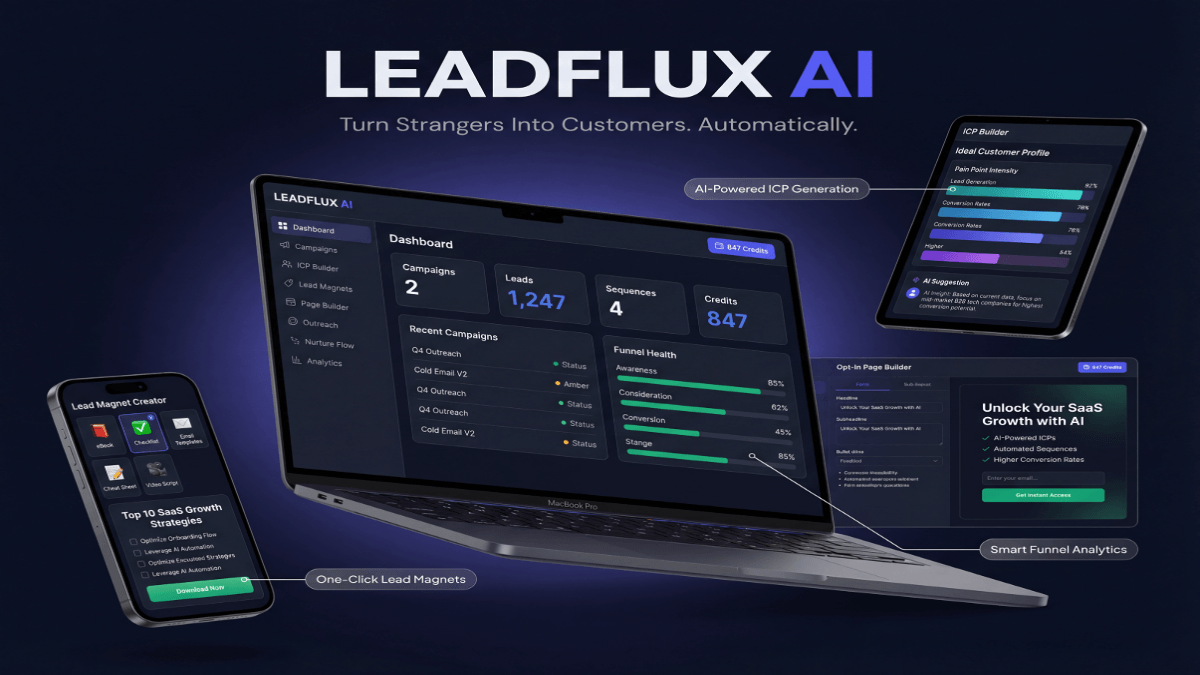
Stop Guessing. Start Converting.
LeadFlux AI Does the Heavy Lifting.
Tracking KPIs is only half the battle — you need a system that turns data into revenue. LeadFlux AI automatically identifies your highest-value prospects, scores leads in real time, and delivers conversion-ready pipelines so you can focus on closing deals, not chasing dead ends.
See How LeadFlux AI WorksEmail 4 (Day 20): The final ask. Last attempt. Be honest that you’re moving on.
Hey [First name], Last one from me, I promise. I’m moving on to new opportunities, but wanted to leave the door open in case things shift on your end. If you ever want to explore [your offer], I’m easy to find. Good luck with [something relevant to them]. [Your name]
This 4-email sequence over 3 weeks typically generates 8–15% response rate from a cold list of 100 prospects. For beginners, that’s 8–15 replies—several of which will be qualified conversations.
Tools That Speed Up Cold Email Lead Generation
Manually sending individual emails doesn’t scale. Use an automation tool to manage sequences, track opens, and log replies. These tools also let you personalize at scale—using variables like [First name], [Company], [Website], etc.
As a beginner, HubSpot Free or Apollo.io are solid starting points. Both let you set up sequences, track opens/clicks, and manage replies without breaking the bank. Once you’re consistently booking calls, upgrade to a tool with more personalization features.
Common Cold Email Mistakes and How to Avoid Them
Mistake 1: Poor list quality. Sending to wrong email addresses or irrelevant prospects tanks your response rate and damages your sender reputation. Solution: Validate your list with a tool like ZeroBounce before any campaign.
Mistake 2: Generic subject lines. “Let’s Connect” or “Quick Question” gets ignored. Your subject line is your only shot at the open. Reference something specific about them or their business.
Mistake 3: Selling too hard. Cold prospects aren’t ready to buy. They don’t know you. Your goal is a conversation, not a closed deal. Remove the sales pitch. Replace it with a specific problem statement and a low-friction next step.
Mistake 4: Sending from a new Gmail account. Gmail accounts with no history, no activity, and no established reputation get marked as spam. Use your company domain email. If you’re bootstrapping, get a cheap domain ($10–15/year) and set up email forwarding or use a cheap hosting plan with email included.
Mistake 5: No follow-up sequences. Single emails don’t work. A sequence of 3–4 emails over 3 weeks generates 3–5x the replies of a single send. Commit to the full sequence.
Measuring What Actually Works
Cold email lead generation for beginners requires tracking. You need to know what’s working so you can do more of it. Track these metrics:
Review your metrics every 2 weeks. A/B test subject lines, email length, and call-to-action timing. Small tweaks—shortening your email from 4 sentences to 3, changing “call” to “audit,” shifting follow-ups by 2 days—can move reply rates from 1% to 3%.
FAQ: Cold Email Lead Generation for Beginners
Q: How many emails should I send per day as a beginner? A: Start with 10–20 emails per day and ramp up over 2 weeks as you warm your sender reputation. Most platforms recommend not exceeding 100–150 per day unless you have a strong domain reputation. More important than volume: list quality and relevance.
Q: What’s a good reply rate for cold email? A: For cold email lead generation, a 2–5% reply rate is healthy. If you’re under 1%, your targeting or message needs work. If you’re over 5%, you’re likely doing something exceptionally well—document it and keep repeating it.
Q: Should I use a Gmail account or my own domain? A: Use your own domain email. New Gmail accounts have low deliverability. A domain email (like [email protected]yourcompany.com) signals legitimacy and improves inbox placement. You can set it up cheaply with a $10 domain and a basic email hosting service.
Q: How long should each email in my sequence be? A: Keep initial emails to 3–5 sentences. Longer emails are skimmed and ignored. Follow-ups can be slightly longer if you’re providing value (a case study, a resource), but aim for 6 sentences maximum. Mobile users are reading on phones—short is convertible.
Q: What if people mark my emails as spam? A: A few spam complaints won’t kill you, but many will tank your reputation. Minimize spam by: only emailing relevant prospects, honoring unsubscribes immediately, using a clean list, and avoiding spam trigger words (“FREE,” “Act now,” “Limited time”). A spam complaint rate above 0.1% is a red flag.
The Long Game: Cold Email as a Lead-Generation Engine
Cold email isn’t a quick fix. It takes 2–3 weeks to see results from a single campaign, and 2–3 campaigns before you dial in what works. But once you have a system—a clean list, proven messaging, sequences running on autopilot—you’re generating leads on-demand without paying per click.
This is the core truth: every successful online business either owns a customer list or is building one. Cold email lead generation for beginners is how you start. You find prospects, you reach them directly, you build relationships. Over time, that list becomes your most valuable asset—it’s traffic you own, not traffic you rent.
The beginners who succeed are the ones who commit to a system: build a targeted list, write 3–4 personalized sequences, send consistently, track results, and iterate. It doesn’t require fancy tools or complex sales techniques. It requires consistency and a willingness to learn from replies and non-replies alike.
Start small. Pick one narrow vertical, build a list of 50 prospects, and run them through a full sequence. Track every metric. Most will ignore you. Some will engage. Those who engage—those are your leads. Refine the message, the list, the sequence. Run it again with 100 prospects. Then 200. Within 2–3 months, you’ll have a repeatable system generating 5–10 qualified conversations per week.
That’s the real value of cold email: predictability. And predictable lead generation is the foundation every scalable online business is built on.