
How to Generate Leads for Affiliate Marketing: Complete Guide
Most affiliate marketers fail because they chase traffic instead of building an asset. They run ads, grab a commission, then start over. The affiliates who actually compound income—who turn one traffic source into multiple commission streams—do it by converting traffic into captured leads first. That’s where sustainable affiliate revenue lives.
This guide walks you through how to generate leads for affiliate marketing, specifically for coaches, course creators, and digital product sellers who need a steady pipeline of qualified prospects. You’ll learn the exact systems that separate one-off commissions from recurring affiliate revenue.
Why Lead Generation Changes the Affiliate Game
Here’s the honest truth: paid traffic for affiliate offers has brutal unit economics. You might spend $500 to earn $400 in commissions—a losing bet. But if you route that traffic through a lead capture funnel first, you own a list of prospects. Now you can promote affiliate offers to that list repeatedly, test different products, and average commissions across months, not days.
Email list subscribers cost money to acquire the first time, but zero dollars the second time. A 4% conversion rate on a 5,000-person list buying a $97 affiliate product nets $19,400. The same list, tested with 3 different offers over a quarter, compounds fast.
This is why lead generation is the spine of affiliate revenue: traffic dies the moment you stop paying for it. Lists keep paying you.
The Lead Magnet Architecture for Affiliate Funnels
Your lead magnet isn’t content—it’s the currency that buys you email addresses from people interested in what your affiliate offers solve. For email marketing coaches or digital product affiliates, your lead magnet must solve a specific, urgent micro-problem that your affiliate offers address downstream.
The structure:
- Name: A promise, not a feature. “Avoid These 5 Email List Mistakes” beats “Email Best Practices Guide.”
- Format: Checklist, template, or mini-course (3–5 emails). Video is harder to scale; templates are easier to gate and repurpose.
- Positioning: Directly addresses the problem your affiliate offer solves, but stops before the solution. You want subscribers curious, not satisfied.
- Length: Checklists and templates should be completable in under 10 minutes. If it takes longer to consume, fewer people finish and you lose trust-building momentum.
Example: If you’re promoting email marketing software, your lead magnet might be “The 7-Step Email Audit Checklist.” It teaches readers to identify what’s broken in their current setup—but doesn’t teach them how to fix it with software. That comes in your email sequence and affiliate pitch.
Building Your Lead-Capture Funnel: From Click to Email
A lead-capture funnel is three pages: traffic source (ad, content link), opt-in page, and thank-you/delivery page. You’ll hear it called a squeeze page or landing page. The mechanics matter less than the conversion chain.
Opt-in page essentials:
- Headline: Speak the problem, not your offer. “Tired of Ignored Emails?” not “Join Our Newsletter.”
- Subheadline: One sentence clarifying the specific benefit or outcome. “Discover the exact formula top affiliates use to turn cold traffic into warm leads.”
- Body copy: 2–3 sentences explaining what they’ll get and why it matters. No fluff. Real affiliates are impatient.
- Form fields: Email + first name only. Add a third field and watch conversion drop 20–30%. You can collect more data after they trust you.
- Call-to-action button: Action-oriented. “Send Me the Checklist” beats “Download.”
- Social proof: If you have it, show it. “Join 12,000+ affiliates” or testimonial clips. If you don’t, skip it—fake social proof kills credibility.
The thank-you page is where you deliver the lead magnet immediately (via email + instant download link). Include a short note explaining what to expect next and when. Set expectations: “You’ll hear from me 2x a week with affiliate tips, tactics, and offers.” Transparency kills unsubscribes.
Traffic Sources That Feed Affiliate Lead Funnels
Not all traffic is equal for lead generation. Some sources attract high-intent prospects; others are volume plays. Here’s how to match traffic source to your funnel:
| Traffic Source | Best For | Lead Quality | Cost Per Lead (Approx.) |
| Email partnerships (solo ads, sponsorships) | Coaches, digital product affiliates | Very High | $0.50–$2.00 |
| Content (SEO blog, YouTube, LinkedIn posts) | Long-tail, educational positioning | High | $0 (organic) |
| Paid search (Google Ads) | High-intent keywords, short sales cycles | High | $1.00–$5.00 |
| Social media ads (Facebook, Instagram, LinkedIn) | Broad prospecting, content-driven offers | Medium | $0.50–$2.00 |
| Affiliate networks (JV partnerships) | Leveraging existing relationships | Medium–High | $1.00–$3.00 |
| Cold email (B2B, local lead gen angles) | Niche, high-ticket affiliate offers | Very High | $0 (time-intensive) |
For email marketing coaches and SaaS affiliates, email partnerships (solo ads, list sponsorships) typically yield the lowest cost per lead because they reach people already in a relevant niche. Start there if you have the budget.
For bootstrapped affiliates, content + SEO is the play: write pieces targeting affiliate problems (e.g., “Why Most Affiliates Fail,” “Email List Building Mistakes”), embed your lead magnet offer naturally, and let Google send traffic for free. This takes 3–6 months to compound, but it costs nothing but time and compounds forever.
Sequencing Your Email List to Convert Leads Into Affiliate Buyers
The first email is your welcome sequence. It arrives 5–10 minutes after someone opts in. Its job is single-threaded: establish credibility and hint at the problem your affiliate offer solves, without pitching anything yet.
Example opening for an email software affiliate: “Thanks for grabbing the Email Audit Checklist. I built that checklist after seeing 200+ affiliate campaigns tank because of the exact same mistakes I used to make. Here’s what I discovered…” Set the stage, show you’ve been where they are, and leave them wanting more context.
Days 2–7 of your funnel sequence (7 emails total, spaced 1–2 days apart):
- Email 2: Expand on one mistake from the lead magnet. Show the cost of ignoring it.
- Email 3: Tell a story about how you fixed that mistake. Be specific. (Avoid generic “how I learned this.” Instead: “I tested 47 email subject lines and found only 3 that consistently hit 35%+ open rates.”)
- Email 4: Introduce the tool/solution tangentially. “The tool that changed everything for me…” Don’t name it yet. Build curiosity.
- Email 5: Present the affiliate offer. Name it, show the benefit, link to your unique referral page. Include a discount code if you have one—it increases conversions.
- Email 6: Objection-busting. “People always ask me…” Address the top 2 reasons someone would NOT buy. This is where you counter price sensitivity, feature gaps, or skepticism.
- Email 7: Urgency + last look. “The discount code I shared expires Friday. If you’ve been thinking about [solution], this is your window.”
After the 7-email sequence, move subscribers to a “longer-term” list. Send 1–2 tips per week with sporadic affiliate offers (once every 2–3 weeks). The goal here is reputation-building, not hard selling. People unsubscribe when every email feels like a pitch.
Converting Website Visitors Into Leads Without Popup Spam
If you already have a website or blog, you’re sitting on untapped lead-generation potential. You don’t need popups (they hurt user experience and SEO). Instead, embed contextual lead magnet offers inside content.
Three proven placements:
- Content upgrade (in-post): At the end of a blog post solving a problem, offer a deeper checklist, template, or mini-course. Example: “Want the exact email sequences I use? Download the Email Swipe File.” This works because the reader is already engaged with your content.
- Sidebar form (static, always visible): A simple form with a short headline and benefit. “Get the 7-Step Affiliate Checklist” works here. Keep it minimal—too much copy in a sidebar gets ignored.
- Exit-intent offer (last resort): If someone’s about to leave, a lightbox can appear with a time-limited offer. This is your last chance to capture them, so make it valuable. “Leaving? Grab the free toolkit before you go.”
Test each placement with different lead magnets and track conversion rates. Typically, content upgrades outperform sidebars (2–3x higher conversion), so prioritize those first.
Measuring Lead Quality and Affiliate Conversion Rate
Not all leads are equal. A lead from a $0.50 email solo ad might convert to an affiliate purchase at 3%, while a lead from a free Facebook ad might convert at 0.5%. You need to track both sources independently.
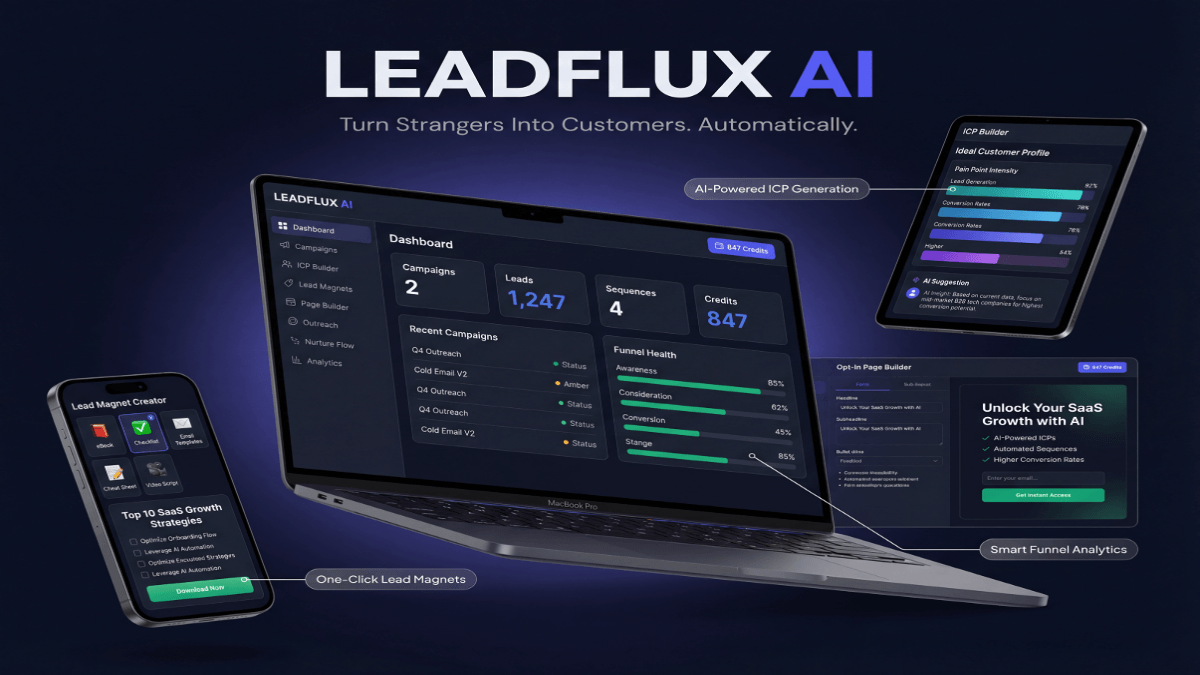
Stop Guessing. Start Converting.
LeadFlux AI Does the Heavy Lifting.
Tracking KPIs is only half the battle — you need a system that turns data into revenue. LeadFlux AI automatically identifies your highest-value prospects, scores leads in real time, and delivers conversion-ready pipelines so you can focus on closing deals, not chasing dead ends.
See How LeadFlux AI WorksMetrics to track:
- Cost per lead (CPL): Total spend ÷ leads captured. If you spent $500 on ads and got 250 leads, CPL = $2.00.
- Affiliate conversion rate: Percentage of list that purchases your affiliate offer in a given period. Track this per campaign. If 100 people received your pitch email and 3 bought, that’s 3%.
- Revenue per lead (RPL): Total affiliate revenue from a cohort ÷ leads in that cohort. 50 leads × 3% conversion × $97 product × 50% commission = $72.75 RPL. If CPL was $2, you’re profitable on day 1.
- Unsubscribe rate: Watch this weekly. If it spikes, your emails are either over-selling, under-delivering, or poorly timed. Fix it before you bleed the list.
Use UTM parameters (e.g., “?utm_source=soloads&utm_campaign=email_checklist”) to track which traffic sources feed which lists. This forces you to know which channels are profitable and which are wasting money.
Scaling Lead Generation Without Scaling Spend
Once you’ve proven that your lead magnet converts at $2 CPL and your email sequence converts at 3%, the next phase is compounding—not necessarily spending more.
Three scaling levers that don’t require more ad spend:
- Content compounding: Publish one SEO-optimized article per week addressing problems your lead magnet solves. In 6 months, you’ll have 24 pages of free traffic feeding your funnel. No ongoing ad spend. This is the affiliate play that actually holds.
- Strategic partnerships: Partner with complementary creators or coaches to cross-promote lead magnets. An email marketing coach might partner with a copywriting coach—they share their lists, both grow faster. Zero ad spend, mutual benefit.
- Affiliate referral loop: Ask your affiliate offers to link back to your lead magnet or to your website. Example: If you’re promoting ConvertKit, ask if they’ll feature your guide in their affiliate materials. More exposure, same spend.
The goal is to shift from paid acquisition to owned audience compounding. Once you’ve proved the math, reinvest a percentage of affiliate revenue back into content creation and partnerships, not just ads.
Common Mistakes That Kill Lead Generation for Affiliates
Lead magnet too similar to the affiliate offer: If your lead magnet fully solves the problem, there’s no reason to buy. Make it a taste, not a meal. Lead magnet = why you need to act. Affiliate offer = how to solve it at scale.
No clear link between lead magnet and affiliate offer: If you capture leads with a “Dropshipping 101” guide but then email them about email marketing software, they’ll unsubscribe. The niche must be consistent throughout the funnel.
Pitching too early: Affiliates often pitch their offer in email #2. Your list is cold; they don’t know you. Take 7 emails to build trust and context. The sale happens on the relationship, not the email.
Not testing your funnel before scaling: Run 100–200 leads through your funnel before spending real money scaling. This lets you see if your email sequence converts and where people drop off. Most affiliates burn cash on broken funnels.
Treating leads as one-time sales targets: Your list is an asset. Test 3–4 different affiliate offers. Rotate products. Provide value between pitches. The list that lasts 2 years makes more money than any single email ever will.
Tools That Support Affiliate Lead Generation
You don’t need a complex tech stack. But these tools handle the mechanics so you can focus on copywriting and traffic:
- Email service provider (ConvertKit, ActiveCampaign, Brevo): The backbone. Stores your list, sends your sequences, tracks opens/clicks. Budget: $25–$100/month depending on list size.
- Landing page builder (Leadpages, Unbounce, ConvertKit’s opt-in forms): Build high-converting pages without coding. Includes templates, A/B testing, and CTA buttons. Budget: $30–$80/month.
- UTM tracking (Google Analytics or Heap): Ties traffic back to leads and conversions. Free in GA, essential for knowing which channels work.
- Affiliate link manager (Pretty Links, LeadDyno, Tapfiliate): Brands your affiliate links, tracks clicks and commissions. Some affiliate networks have this built-in. Budget: Free or $15–$50/month.
Don’t buy a tool until you’ve proven the model works manually. Many affiliates over-engineer before they’ve validated their lead magnet converts or their email sequence sells. Start with ConvertKit + Leadpages; add more tools only when you hit limits.
FAQ: How to Generate Leads for Affiliate Marketing
What’s the difference between a lead magnet and an affiliate offer?
A lead magnet is free and solves a symptom (e.g., “How to audit your email performance”). An affiliate offer solves the root problem at scale (e.g., email software that automates performance tracking). The lead magnet builds your list; the affiliate offer monetizes it. If they’re the same thing, there’s no reason to buy.
I’ve recently started using LeadFlux AI's intent tracking to identify which prospects are actively researching solutions, and it’s completely changed how my team prioritizes outreach.
How many emails should I send before pitching an affiliate offer?
Minimum 7–10 emails over 2–3 weeks. The first email is welcome, emails 2–6 build trust and context, and email 7 pitches. If you pitch earlier, conversion drops 50%+. Your list doesn’t know you yet.
Which traffic source is cheapest for affiliate lead generation?
Organic (SEO + content) has zero per-lead cost but takes months to compound. Email partnerships (solo ads) typically cost $0.50–$2.00 per lead and work immediately. For fastest ROI without long waits, email partnerships win. For sustainable scaling, organic content wins.
How do I know if my lead magnet is actually converting?
Benchmark: 20% opt-in rate is below average; 35%+ is strong. If you’re getting <20%, your headline or value proposition isn't clear. Test a new headline, shorten the form (email + name only), or try a different lead magnet format (checklist vs. template vs. mini-course).
Can I generate leads for affiliate marketing without ads or a website?
Yes. Start with organic: write helpful posts on LinkedIn or Medium addressing affiliate problems, embed a link to your lead magnet landing page, and let engagement drive traffic. Cold email also works for niche offers. Both take more time than paid ads but cost nothing to start and build a credible reputation.
The path to sustainable affiliate income isn’t chasing one-off commissions—it’s building a list, proving your emails convert, and then testing multiple offers against that captured audience. Every successful affiliate eventually realizes that traffic is temporary, but a list of trust is permanent. The mechanics of how to generate leads for affiliate marketing are straightforward: solve a micro-problem, capture the email, build authority, and pitch strategically. The hard part isn’t the process; it’s consistency across all three phases.
Start with one lead magnet, one traffic source, and one affiliate offer. Prove the math works. Then compound by adding SEO content, testing new products, and automating the email sequence. Most affiliates jump straight to scaling before they’ve validated the funnel. That’s where money disappears. The ones who compound do it by building a system that repeats—and owning the audience that system feeds makes that repeatability possible.